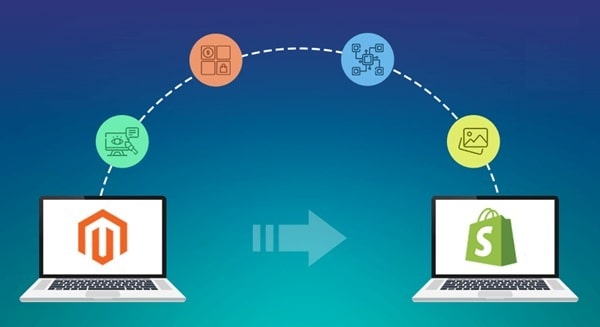
Shopify migration is a complex, multi-level process that requires precision, experience, and a deep understanding of eCommerce infrastructure. That’s why brands with large catalogs, personalized functionality, or high SEO requirements turn to Binary Future’s level of partners. The team specializes in seamless Shopify migration, ensuring data, design, and integration migration without loss or downtime.
Why Shopify has become the platform where brands are migrating en masse
In the third quarter of 2024, Shopify recorded a 26% increase in GMV to $1.55 billion, up from $1.23 billion in 2023. During the same period, the number of active stores increased to 4.6 million. Over 85% of businesses on Shopify use apps, which indicates the flexibility and scalability of the ecosystem.
For businesses, this means stability, speed of development and huge room for growth. But to get these benefits, the transition must be done wisely – preserving SEO, structure, data, technical settings and UX. Binary Future builds the process exactly like this: without disruptions and chaos, with full transparency at every stage.
Who is Shopify for and why brands are choosing to switch?
The platform allows you to manage content, customize page structure, work with media, tags, collections, large catalogs, multiple users, and theme coding. An integrated AI store builder generates designs based on your business description, and over 800 responsive themes make it easy to get started.
Binary Future works with Shopify to ensure that the brand receives not just a port, but a strong technical foundation: optimized speed, a modern interface, clean code architecture, and correct work with large data sets.
Preparing for seamless Shopify migration: how Binary Future does it
During the planning phase, the team develops a clear understanding of the business goals. These could be scaling, faster UX, entering new markets, or migrating to a more stable platform. For example, one company needed a website with a rich catalog of tours and easy navigation – a task that Shopify solves much more efficiently than previous CMSs.
Binary Future conducts an inventory of content, products, collections, customers, orders, media, custom features, and SEO elements. At the same time, risks, dependencies, URL structure, metadata, technical modules, and integrations are assessed. This is the foundation on which an accurate migration strategy is built.
How to migrate to Shopify: a chaos-free process
After setting up the basic Shopify store, the team migrates content: products, variants, customers, order history, reviews, pages, CRM data. To avoid duplicate emails, email notifications are temporarily disabled.
Binary Future pays special attention to search as one of the key elements of conversion. After transferring the content, the team checks the correctness of tags, filters, recommendations and collection logic, configures advanced search or Shopify Plus functionality if necessary.
After the content comes the design block: migrating or redesigning the theme, adapting styles, testing interfaces, and customizing the mobile version. It is at this stage that brands often update their style – from colors to UX patterns.
This is especially important in digital niches where visuals play a critical role. For example, in one brand that migrated to Shopify, visual style directly influenced user interaction with AR filters.
Technical SEO work is carried out in parallel: creating a Sitemap, checking indexing, setting up redirects, testing crawlability, identifying problem pages, and working on 404.
The most critical step in migrating to Shopify is preserving SEO
Google holds 79% of searches (Bing – 12%), so any mistake can reduce visibility.
Binary Future captures all old URLs before migration, generates a mapping table, configures 301 redirects, and minimizes the risk of 404 errors.
Content, structured data, media, internal links, and navigation logic are reviewed. The team then connects to Google Search Console for final testing and fixes any technical issues.
Testing before launching a new store on Shopify
At this stage, all scenarios are tested:
· adding products to the cart,
· design,
· payment,
· order confirmation,
· mobile adaptation,
· navigation and search.
Binary Future uses its own checklists that cover UX, technical aspects, speed, images, behavioral factors, and integrations.
After launching a business on Shopify: monitoring and optimization that impact growth
The first 30 days become a period of active analytics: views, clicks, sales, behavioral signals, possible errors and trends. All of this is compared to the previous platform.
1. Content is updated, adapted, and optimized.
2. SEO is adjusted to the new structure.
3. UX is refined based on heatmaps and analytics.
Binary Future works with the brand even after launch, ensuring stability and further growth.
Tools used for migrations
For simple migrations, CSV import is suitable, for more complex ones, Cart2Cart or Matrixify. The largest projects are carried out through API integrations and custom scripts. Before each migration, backups are created via FTP or SSH and a DNS change is prepared – this guarantees security and no losses.
Seamless Shopify migration is not just about transferring products or structure. It’s a technical strategy, SEO plan, UX redesign, data validation, stability, and control of all business processes.
Binary Future implements migrations so that the store is immediately fast, scalable, clean in terms of code, optimized for sales, and ready for long-term growth.